



The World’s First AI-Designed Lens Optic Comes to the U.S. at Tylock Nasser Vision
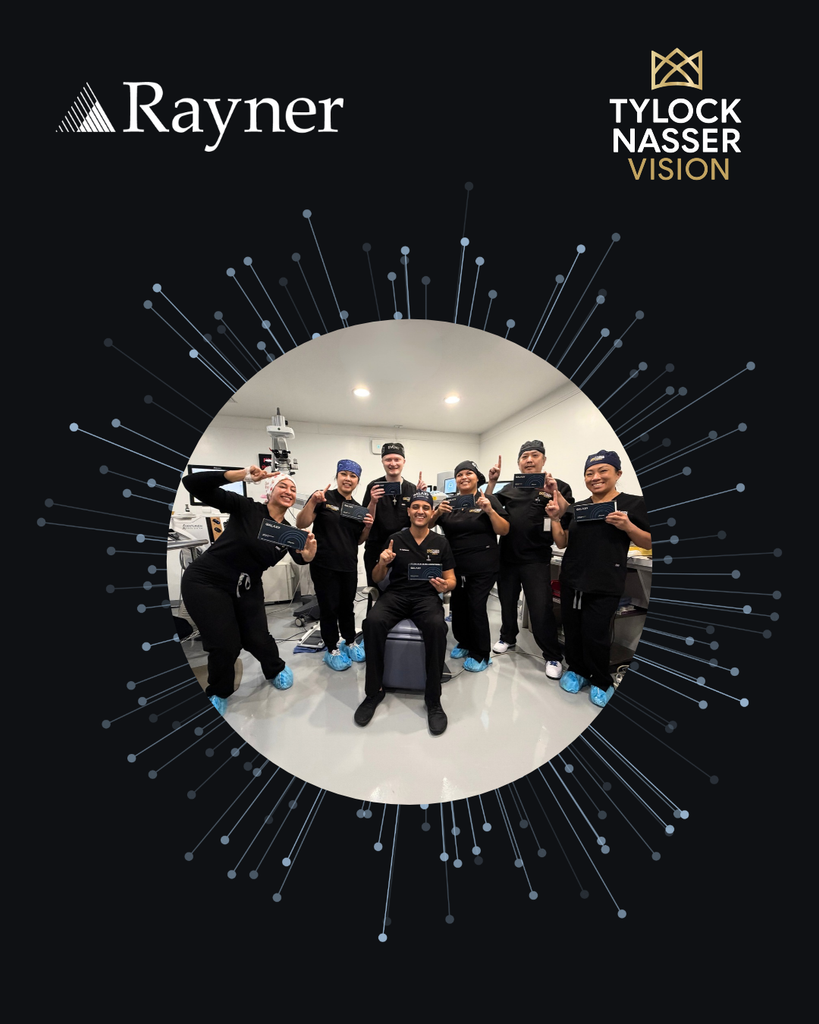
On October 12, 2026, Dr. Taj Nasser performed the first commercial implant of the RayOne Galaxy lens in the United States. It happened here in North Texas, at Tylock Nasser Vision.
The RayOne Galaxy is the world’s first intraocular lens optic designed with artificial intelligence. Rayner used a proprietary AI engine, trained on real patient outcomes, to shape its spiral optic. The result is a lens built to deliver a continuous range of vision with fewer of the halos and glare some patients notice with other premium lenses.
The FDA approved the Galaxy on September 24, 2026, and we were proud to be the first practice in the country to bring it to patients. Those first patients will be familiar to Rangers fans: Steve Buechele and Mark McLemore, former Texas Rangers players who later shared the broadcast booth.
Here is what this lens is, why it matters, and what it could mean for you.
What Is the RayOne Galaxy Lens?
The RayOne Galaxy is a premium lens implant used during cataract surgery. When a cloudy natural lens is removed, the Galaxy takes its place. It is designed to give clear vision at distance, intermediate and near ranges, so many everyday tasks no longer depend on glasses.
The Galaxy debuted internationally in 2024 and has since been approved in about 75 countries. Before FDA approval, it was studied in more than 250 patients at 10 U.S. clinical sites.
The Company That Made the First Lens Implant
The Galaxy comes from Rayner, the British company that made the first intraocular lens in history. In 1949, Sir Harold Ridley implanted that first Rayner lens in London. It changed cataract surgery forever: before Ridley, patients left surgery depending on thick glasses to see. Today, lens implants are part of millions of cataract procedures every year!
Rayner launched the Galaxy on the 75th anniversary of that first implant. The company that started it all is still leading what comes next.
How AI Shaped the Spiral Design
Many lenses that correct for both distance and near vision use rings or steps on the lens surface to split light into separate focal points. That approach works, but some patients notice halos or glare around lights, especially at night.
The Galaxy takes a different path:
- Designed with artificial intelligence. Rayner’s AI engine studied patient outcomes to find the spiral shape. It is the first lens optic created this way.
- A smooth spiral optic. Focus shifts gradually across the lens surface, with no rings or steps. The goal is a continuous range of vision rather than a few fixed points.
- Non-diffractive. According to Rayner, the lens loses none of the light passing through it, so more light reaches the retina.
- Fewer night-vision disturbances. The design aims to reduce halos and glare. In the U.S. study, patients reported low levels of bothersome visual effects.
A First for the Country, Close to Home
Being first is not about a headline. It reflects years of work by our team to bring proven, advanced technology to our patients as soon as it is available.
“For years, patients have asked me for a lens that gives them a full range of vision without trading away comfort at night. The Galaxy is the closest we have come to that. Being the first practice in the country to offer it is an honor, but what matters most is what it means for the person in the chair: more freedom to see the way they want to live. Seeing Steve and Mark walk out of surgery as the first two patients made that real for our whole team.” – Dr. Taj Nasser
Two Rangers, One Shared Decision
Steve Buechele and Mark McLemore spent years in front of Rangers fans, first on the field and then on the air, where they called games together for three seasons. They are longtime friends, and they made this decision about their vision side by side.
We will share more of Steve’s and Mark’s stories in the weeks ahead, including video from their surgery day.
Who May Be a Good Candidate for the RayOne Galaxy Lens?
The Galaxy may be a fit if you:
- Have cataracts and are planning surgery
- Want to rely less on glasses for reading, computer work and driving
- Are concerned about halos or glare at night
- Have healthy eyes otherwise (your cornea, retina and optic nerve all play a role)
No single lens is right for everyone. Dr. Nasser will review your eye health, lifestyle and goals before recommending the right option for you.
Galaxy Toric for Astigmatism
If you have astigmatism, the RayOne Galaxy Toric offers the same AI-designed spiral optic with built-in astigmatism correction. Many patients can address cataracts, astigmatism and range of vision in one procedure.
Schedule Your Consultation
Clear vision gives you the freedom to live fully. If you are considering cataract surgery and want to learn whether the RayOne Galaxy lens is right for you, schedule a consultation at our Irving or McKinney office.
Individual results vary. A consultation with an eye care professional is needed to determine candidacy.
Frequently Asked Questions
What is the RayOne Galaxy lens?
It is a lens implant placed during cataract surgery. Its spiral optic, designed with artificial intelligence, is built to provide clear vision at distance, intermediate and near ranges.
What does “AI-designed” mean for a lens?
Rayner used an artificial intelligence engine trained on patient outcomes to create the Galaxy’s spiral shape. AI was used to design the optic. It does not run inside your eye or require any technology after surgery.
Is the RayOne Galaxy FDA approved?
Yes. The FDA approved the RayOne Galaxy and Galaxy Toric on September 24, 2026, after a U.S. study of more than 250 patients.
How is a spiral lens different from a trifocal lens?
Many trifocal lenses use rings to split light into set focal points. The Galaxy uses a smooth spiral surface that shifts focus gradually, which is designed to reduce halos and glare.
Who makes the RayOne Galaxy?
Rayner, the British company that made the world’s first intraocular lens, implanted by Sir Harold Ridley in 1949.
Can the Galaxy lens correct astigmatism?
Yes. The RayOne Galaxy Toric version corrects astigmatism along with your range of vision.
Where can I get the RayOne Galaxy lens in North Texas?
Tylock Nasser Vision offers the Galaxy at our Irving and McKinney offices. Dr. Taj Nasser performed the first U.S. commercial implant in October 2026, with former Rangers Steve Buechele and Mark McLemore among the first patients.
Will I still need glasses?
Many patients rely much less on glasses after a premium lens, but results vary. Dr. Nasser will talk through realistic expectations during your consultation.
Sources
Rayner: RayOne Galaxy product page
Eyewire: FDA approves Rayner’s RayOne Galaxy
Glance: FDA approves RayOne Galaxy spiral IOL